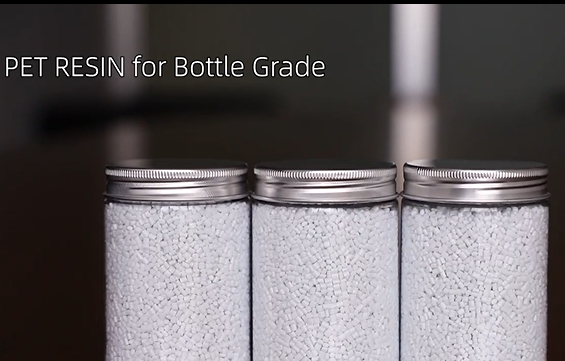
55±5% Crystallinity Stable Viscosity PET Resin for Natural Mineral Water Bottles
Problem
Producers of natural mineral water report random wall-thinning, neck cracking and uneven bottle weights that appear without any change in machine settings.
Scrap spikes on a single shift, and the cause is hard to trace because the bottles look acceptable on the conveyor.
Lightweighting programs make this worse, because thinner walls reduce the safety margin that used to hide resin variation. Bottles that once passed drop and top-load tests now fail on a random basis.
Operators then compensate by adding weight back, which cancels the savings the lightweighting project was meant to deliver.
Cause
The root issue is batch-to-batch variation in crystallinity and melt viscosity, which changes how the preform stretches.
When IV drifts more than about ±0.03 dl/g, preform heat uptake shifts and the stretch ratio no longer matches the mold.
Low or uneven crystallinity also lowers the thermal stability of the bottle base during hot-fill and pasteurization.
Crystallinity sets the stiffness of the bottle base, while viscosity governs how the preform stretches. When either value drifts, the preform and the mold no longer work together, producing uneven walls and weak necks.
Resin that sits warm or is conveyed roughly can also pick up fines and moisture, adding a second source of variability on top of the polymerization difference.
Solution
This grade holds crystallinity in a controlled 55±5% band and viscosity within ±0.01 dl/g between lots.
Stable viscosity means the preform heats predictably, giving uniform wall distribution and consistent bottle weight.
Balanced crystallinity raises base thermal stability, so mineral water bottles resist deformation during warm filling and transport.
Tight lot-to-lot control of both crystallinity and viscosity removes that guesswork, so one machine recipe holds for weeks. Producers gain a stable process window instead of constantly chasing resin variation.
Because the base stays thermally stable, bottles survive warm storage and stacking without deforming.
Selection Guide
- Use 0.78-0.80 IV for lightweight 500 mL mineral water bottles.
- Choose 0.80-0.82 IV for 1.5 L and larger formats that need more top-load.
- Where line speeds exceed 15,000 bph, specify the tightest viscosity tolerance available.
- Verify incoming resin IV per lot; consistency matters more here than a single peak value.
Application Scenarios
- Natural mineral water and spring water bottles.
- Mid-to-large format still-water bottles (1.5 L to 5 L).
- Lines that require stable bottle weight for lightweighting programs.
FAQ
Why does crystallinity control matter for water bottles?
It governs base stiffness and thermal stability, which directly affect how the bottle survives warm storage and stacking.
How does stable viscosity help my line?
Predictable melt viscosity keeps preform heating uniform, cutting wall-thinning and scrap without machine changes.
Can this resin be lightweighted?
Yes. Stable IV and crystallinity support 10-15% weight reduction on well-tuned lines.
What is the recommended preform drying?
Dry to below 50 ppm moisture at 160-170°C before injection.
IV Viscosity Differences & Bottle Type Matching
The main difference between the PET grades is the IV viscosity of PET, which decides the type of bottle each grade is used for:
| Type |
IV Viscosity (dL/g) |
Bottle Type |
| CZ-302 |
0.800±0.015 |
Potable water bottle |
| CZ-302L |
0.780±0.015 |
Potable water bottle (Min) |
| CZ-318 |
0.830±0.015 |
Oil / cosmetics bottle, APET sheet & roll |
| CZ-328 |
0.860±0.015 |
CSD bottle |
| CZ-328A |
0.855±0.015 |
CSD bottle (fast reheat) |
| CZ-333 |
0.800±0.015 |
Hot fill bottle |
| CZ-328H |
0.875±0.015 |
Gallon bottle |
Low IV (0.780–0.800 dL/g) suits thin-wall still water and hot fill bottles; medium IV (0.830 dL/g) suits oil, cosmetics and APET sheet / roll; high IV (0.855–0.875 dL/g) builds the wall strength and stress-crack resistance needed by CSD, fast-reheat and gallon bottles.


 Your message must be between 20-3,000 characters!