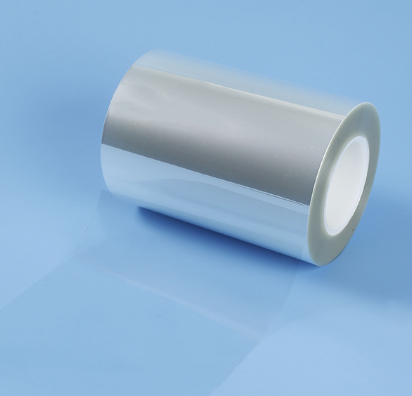
High Tensile Strength BOPET Film — 230MPa Printing & Lamination Grade
Modern rotogravure and flexo presses run faster than ever, and the limiting factor is often the substrate, not the machine. This BOPET film is built with ≥230 MPa machine-direction tensile strength so that thin-gauge webs survive high tension, rapid acceleration and the thermal load of drying tunnels without necking, sagging or breaking.
Problem
Converters pushing 12-15 μm film on high-speed rotogravure lines see recurring web breaks, tension flutter and register drift. As the web is pulled through multiple print units and a drying tunnel, insufficient MD strength lets the film elongate elastically; the register moves between colours, and at the limit the web fractures at a splice or a roller nip. The usual workaround — dropping press speed — directly cuts output.
Cause
The tensile strength of biaxially oriented PET is governed by intrinsic viscosity (IV) and the stretch ratio applied during orientation. A low-IV chip or a conservative stretch leaves residual chain mobility, so MD tensile falls and elongation rises. Thermal effects compound this: at drying-tunnel temperatures, residual orientation relaxes, reducing effective modulus exactly when tension peaks. Unbalanced MD/TD stretching also creates cross-web weakness that shows up as edge tears.
Solution
This grade uses a high-IV film-grade chip and a high MD/TD stretch ratio, producing strong, well-aligned molecular chains. The result is ≥230 MPa MD and ≥220 MPa TD tensile with controlled elongation, so the web holds tension without permanent deformation. A heat-set finishing step limits shrinkage to ≤2.5% MD and ≤0.3% TD at 150°C, keeping register stable through the dryer. Friction is controlled at 0.30-0.50 to give clean tracking without blocking on the roll.
Application
Ideal as the print or lamination base for high-speed flexible packaging: snack and confectionery wrappers, sachets, labels and general laminates. It is equally suited to adhesive-tape backing and metallising base where a strong, thermally stable web is needed.
FAQ
Q: Will the higher tensile change my printing parameters?
A: No. The film runs on standard presses; the added strength mainly increases the tension window and reduces web-break risk at high speed.
Q: Is the surface treated for ink adhesion?
A: Yes, corona treatment to ≥38 mN/m is available on one or both sides for reliable ink and adhesive anchorage.
Q: How is the film delivered?
A: On 3 inch or 6 inch cores, slit to your width, suspended pallet or horizontal roll with edge protection.
Q: What tolerances are offered?
A: Thickness ±2%, width ±1 mm on slit rolls, with full test certificates per batch.
Running a high-speed press? Tell us your line speed and web width and we will recommend the matching gauge and treatment.


 Your message must be between 20-3,000 characters!