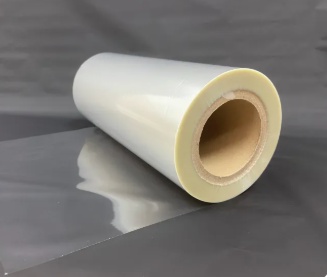
Stable Thickness BOPET Film — Average Deviation ≤±2% Coating & Lamination Grade
When a film is coated or laminated, every micron of thickness variation becomes a variation in the finished product. This BOPET film is produced with an average thickness deviation of ≤±2%, giving converters a flat, predictable web that holds coating weight and register across the full width and length.
Problem
Producers of coated and laminated film see coating weight drifting across the web, gauge bands that show as visible streaks, and register moves between print stations. Downstream, customers reject the finished roll because barrier or optical performance varies from edge to edge even though the average specification is met.
Cause
Thickness variation originates upstream in the extrusion die and the stretching process. If the die profile is not perfectly flat, or if MD/TD stretching is not even, the finished film develops gauge bands. Every subsequent process measures the film locally, not on average: a coater applied at constant pressure deposits more material on thick zones, so coating weight and, with it, barrier and colour vary across the web. Register is similarly disturbed because the effective diameter at the print nip changes with local thickness.
Solution
This grade is built around precise extrusion control and online thickness gauging that corrects the die profile in real time, holding the average deviation to ≤±2%. The biaxial stretching stage is balanced so that the cross-web profile stays flat from edge to edge. The result is a web whose local thickness is close to its nominal value at every point, so coating weight, adhesive lay-down and print register remain stable throughout the run.
Application
Ideal as a coating and adhesive-lamination base where uniformity drives quality: barrier coatings, heat-seal and primer layers, release liners, and laminated structures for food and industrial packaging. Also suitable for any process using gravure, reverse-roll or slot-die coating.
Selection Guide
Specify the stable-thickness grade whenever coating weight or register uniformity is a specification, not just a preference. If your process is insensitive to small gauge variation, a standard tolerance grade is more economical.
FAQ
Q: How is average deviation defined?
A: It is the average of absolute thickness readings taken on a grid across the web, expressed as a percentage of nominal thickness.
Q: Does the tighter tolerance raise cost?
A: There is a modest premium for the tighter control, but it typically reduces coating waste and rejects more than it costs.
Q: Is thickness data supplied?
A: Yes. A batch certificate with measured thickness profile and average deviation is provided with every roll.
Q: Can it be supplied pre-treated?
A: Yes, corona treatment to ≥38 mN/m can be added on one or both sides for coating adhesion.
Share your coating process and target weight and we will supply a profile-verified roll for your line trial.


 Your message must be between 20-3,000 characters!